


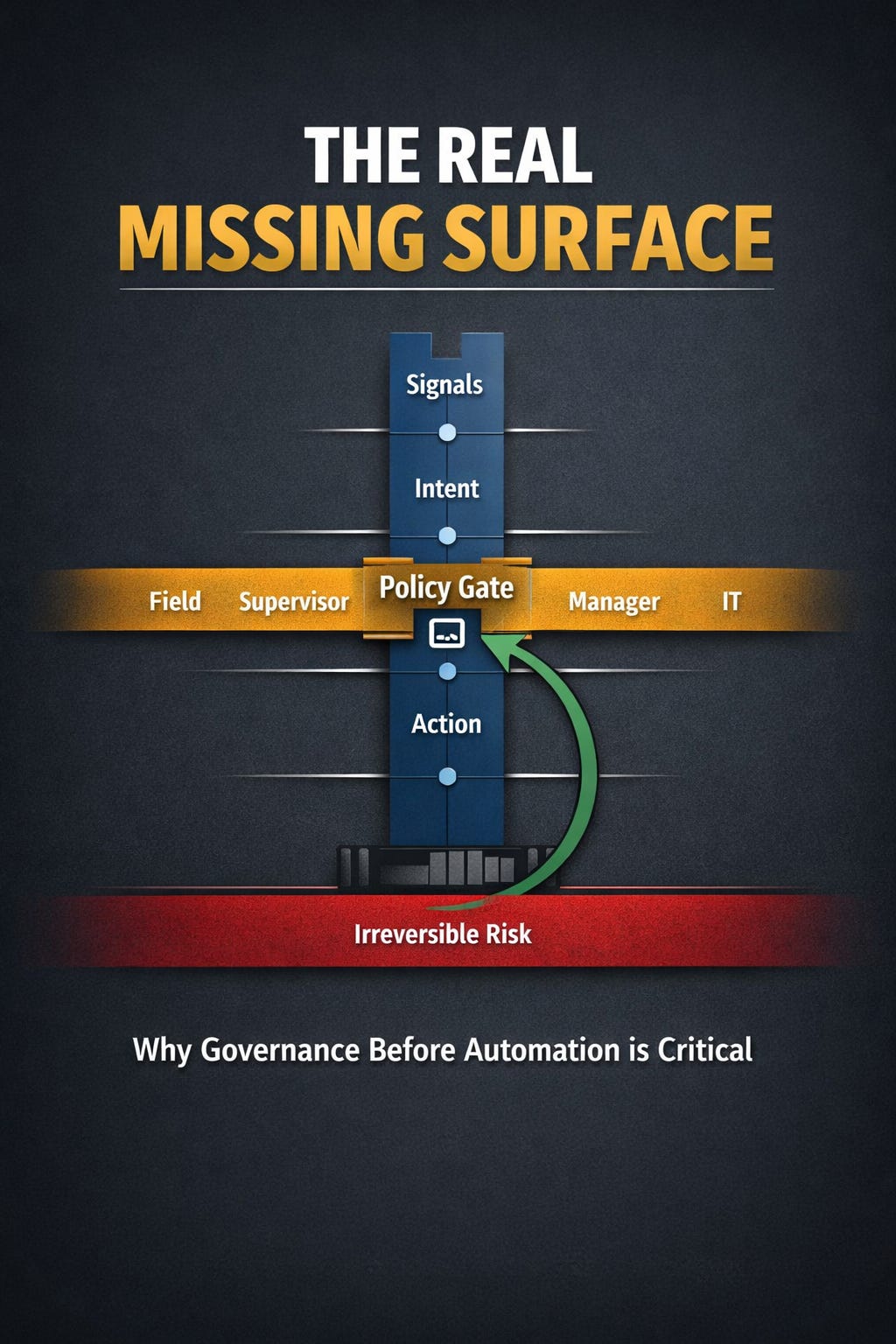
We keep putting AI inside the mobile app as if autonomy were a feature. A suggestion here. A chatbot there. A smarter checklist.
But autonomy doesn’t live inside a screen.
It lives in the transfer of authority.
The real question isn’t whether the model is accurate. It’s whether the right human sees the right evidence before an irreversible decision propagates across inventory, finance, and customer trust.
That’s the moment autonomy either earns its place — or quietly becomes accelerated chaos.
And if that moment isn’t intentionally designed, autonomy doesn’t scale. It leaks risk.
Which leads to the real problem.
The Real Missing Surface
The missing product surface in autonomous field operations is not another model.
It’s not better prompts.
It’s not generative summaries.
It’s not a smarter dashboard.
It’s role-specific controllability.
The right evidence.
The right authority.
At the right moment.
Delivered through the right channel.
The operator interface isn’t a single screen.
It’s a distributed control system made of role surfaces.
And most organizations don’t know they’re missing it.
Autonomy Doesn’t Break in the Model
It breaks in the boring places.
A late sync rewrites inventory reservations.
A device clock drifts.
A payment clears at the bank but not in ERP.
A driver scans “delivered” offline.
An override happens with no rollback path.
Autonomy fails where partial truth meets irreversible action.
That’s not a machine learning problem.
That’s a governance architecture problem.
Think of autonomy not as intelligence — but as acceleration.
If your governance is weak, autonomy accelerates mistakes.
If your governance is strong, autonomy accelerates trust.
The Illusion of the “Operator App”
Most implementations follow this pattern:
Improve the field worker app
Add AI suggestions
Add approval flows in back office
Add dashboard visibility
This is like installing a jet engine on a car while keeping bicycle brakes.
Field operations — warehouse, service, last-mile — operate under constant entropy:
Intermittent connectivity
Stale financial data
Human interruptions
Safety constraints
ERP latency
Real-world unpredictability
And they execute decisions that propagate:
Inventory → Finance → Claims → Customer trust → Partner SLAs
The real design problem isn’t UI elegance.
It’s authority distribution.
Who can act?
Under what constraints?
With what evidence?
With what reversibility?
That’s the product.
A Control Surface, Not a Screen
In aviation, the cockpit isn’t a chat interface.
It’s a control surface.
Every lever, dial, and switch corresponds to:
A defined authority
A defined scope
A defined consequence
A defined fallback
Autonomous field operations need the same discipline.
Not more screens.
Control surfaces.
The Role Surface Matrix
A role surface is defined by:
Actor × Moment × Intent × Authority × Evidence × Channel
Here’s what that looks like in practice:
| Actor        | Moment              | Intent                             | Authority                         | Evidence (minimum)                               | Channel                |
| ------------ | ------------------- | ---------------------------------- | --------------------------------- | ------------------------------------------------ | ---------------------- |
| Field worker | Begin-day           | Build a plan that survives reality | Bounded autonomy                  | Route, inventory confidence, pre-authorizations  | In-app plan canvas     |
| Field worker | In job              | Execute and adapt                  | Propose changes, request approval | What changed, confidence, rollback window        | In-app micro-decisions |
| Supervisor   | Under time pressure | Triage exceptions                  | Scoped override, veto, escalate   | Policy reason codes, blast radius, rollback path | Push + deep link       |
| Manager      | Any time            | Assess systemic risk               | Adjust policy                     | Drift, hotspots, SLA breaches                    | Risk brief             |
| IT / Ops     | After incidents     | Refine governance                  | Policy authoring                  | Evidence ledger, incident timeline               | Policy console         |
Two non-negotiable truths:
Channel is delivery — not authority.
Authority derives from policy — not interface location.
If those blur, autonomy becomes political instead of operational.
Scene 1: Credit Hold Under Time Pressure
A supervisor stands at dispatch.
Drivers staged.
High-value delivery.
12 minutes to departure.
ERP flags: Credit Hold.
The model says: block.
Partial truth:
Payment cleared at bank
ERP not synced
Field shows stale balances
Release delivery:
Goods leave
Invoice posts
Carrier paid
Reversal expensive
Block delivery:
SLA breached
Customer escalates
Rework triggered
Most systems show:
“Override credit hold? Yes / No”
That’s not governance.
That’s abdication.
A proper role surface would show:
Settlement evidence
Policy reason codes
Estimated blast radius
Rollback path (recall workflow, invoice reversal)
Delegation option with SLA
Logged decision ID tied to downstream actions
That is controlled autonomy.
Not binary approval.
Scene 2: Scan vs GPS Conflict
Driver scans package QR and delivers.
Photo attached. Timestamp captured.
GPS telemetry later suggests otherwise.
Clock drift.
Offline sync.
Latency.
System auto-closes stop. Invoice issues.
Later: dispute.
Now you have:
Chargebacks
Claims
Manual reconciliation
Blame
The failure wasn’t prediction.
It was missing evidence packaging.
A dispatcher surface should show:
Raw event IDs
Device vs server timestamp
GPS accuracy
Route context
Confidence score
And allow structured action:
Accept
Flag
Open claims
Reopen stop with compensation path
Again:
Not smarter AI.
Better governance surface.
The Intent → Policy → Surface Pipeline
Here is the minimal architecture that keeps autonomy governable:
Signals
   ↓
Intent Inference
   ↓
Evidence Packaging
   ↓
Policy Gate
   ↓
Action or Exception
   ↓
Role Surface Delivery
   ↓
Feedback → Policy Refinement
This is the real autonomy engine.
Not the model.
The policy gate.
The Evidence Ledger: The Unsexy Foundation
Every autonomous system needs an evidence ledger that answers:
Who knew what?
When did they know it?
Under what confidence?
What policy version applied?
What irreversible action followed?
Without this:
You can’t audit
You can’t improve policy
You can’t defend disputes
You can’t trust the system
Autonomy without an evidence ledger is unmanaged acceleration.
The Override Design Spec
Overrides are where systems reveal their maturity.
A real override must define:
Scope
What exactly can be overridden?
Mandatory Context
Why blocked? What data is stale? What’s the impact radius?
Structured Actions
Approve, veto, delegate, request evidence.
Safe Default
What happens if no one acts?
SLA & Quotas
Prevent rubber-stamping.
Learning Loop
Feed override patterns into policy refinement.
If overrides don’t improve policy, they rot culture.
What Executives Should Fund First
Before more models, fund:
A durable evidence ledger
An exception queue designed as a product
Role surfaces per actor
Scoped overrides with rollback
Testable, versioned policy packs
Buy governability.
Not demos.
The Deeper Shift
We don’t need AI “inside the mobile app.”
We need:
Authority visible before action.
Evidence packaged before decision.
Rollback designed before automation.
The interface of autonomy is not a chat box.
It is authority, evidence, and reversibility — delivered at the right moment to the right human.
Design those surfaces first.
Then let models act.