


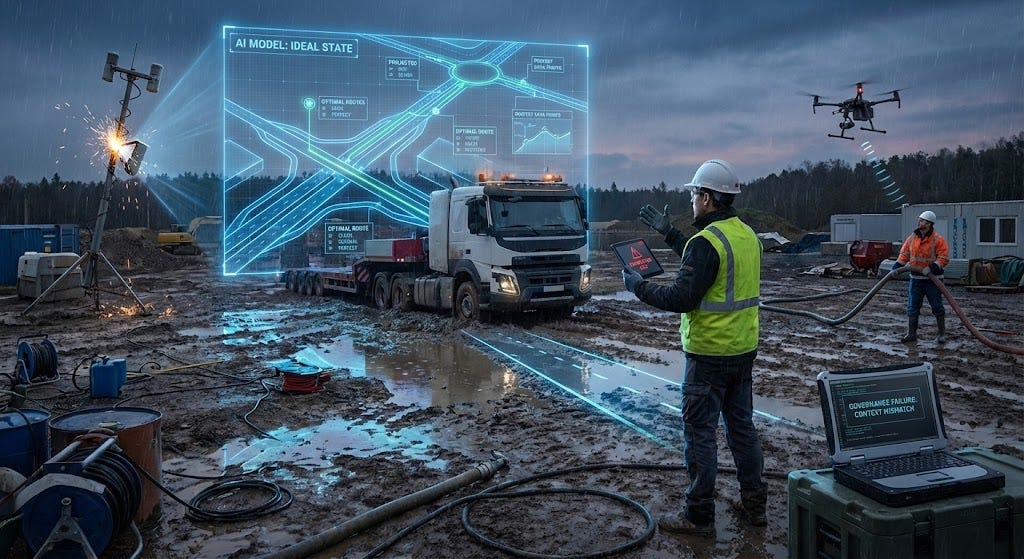
In a demo, there is no missing data. No delayed signals. No human shortcuts. No equipment failures. The system performs beautifully—until it meets the real world.
This is not a minor flaw; it is the central illusion of modern AI adoption.
We tend to measure intelligence by performance in ideal conditions. But the real test of intelligence is behavior under ambiguity, partial failure, and incomplete context.
Field operations—logistics, service, inspections, maintenance, last-mile delivery—are where this illusion collapses first.
The Demo Fallacy
In demos, AI systems operate in sanitized environments:
Clean, complete datasets
Perfectly aligned definitions
Instant feedback loops
Clearly defined goals
Reality looks nothing like this.
In the field, data arrives late—or not at all. Sensors drift or contradict each other. Humans improvise, shortcut, override, and forget. Context is fragmented across systems, roles, and time.
When AI fails here, we blame the model. That’s a mistake.
Most AI failures in operations are not intelligence failures. They are context and governance failures—made visible by automation.
Why “Smarter Models” Don’t Fix This
Large Language Models (LLMs) and modern AI systems are powerful pattern engines, but they are not grounded observers of the physical world. They have no lived experience, no direct perception, and no internal world model. They rely entirely on what we feed them.
This creates three structural limitations:
No Intrinsic Grounding: AI cannot verify reality. It cannot “look outside.” It only infers from inputs.
Context Fragility: Too little context leads to hallucination. Too much context leads to dilution and confusion.
Benchmark Bias: Models are rewarded for answering, not for abstaining. Silence is treated as failure; confident guessing is treated as success.
This works in tests. It fails in operations.
The question isn’t “How do we make models smarter?” The real question is: “How do we organize reality so intelligence has something solid to work with?”
Context Is Not a Prompt Problem
Context does not live in prompts. It lives in systems.
In field operations, “context” is scattered across mobile devices, human inputs, IoT sensors (temperature, vibration, pressure), telematics, camera feeds, ERPs, and informal human knowledge.
Most organizations treat these as separate realities. AI is then asked to reason across them without a shared frame of reference. That’s not intelligence—that’s improvisation.
The Edge is where mistakes become irreversible. Operational failures near the edge behave differently than failures in the center. A missed dashboard update is recoverable. A missed delivery or a wrong safety inspection is not.
The closer you get to the edge—where humans, machines, and incomplete information meet—the more costly mistakes become.
This is why autonomy in field operations is not primarily an AI problem. It is a governance problem
The Solution: Digital Twins as Reality Interfaces
Digital twins are often misunderstood as fancy 3D simulations. That’s a shallow view. Their real value is acting as Reality Interfaces.
A proper digital twin:
Continuously ingests signals from the physical world.
Aligns signals with business structures and constraints.
Maintains temporal awareness (knowing what data is stale, delayed, or missing).
Preserves uncertainty instead of flattening it.
Most importantly, it gives AI something rare: A coherent, evolving representation of reality. Not a perfect one, but a governed one. This is how you stop pretending the map is the territory—while still using maps effectively.
Revisiting the OODA Loop
The OODA loop—Observe, Orient, Decide, Act—remains relevant for a reason.
Most AI effort focuses on Decide and Act. But real failures happen earlier.
Orientation is where reality is interpreted. If your orientation is wrong, every downstream action is wrong—no matter how “intelligent” the model appears. Orientation is built from sensed reality, historical context, human judgment, and organizational constraints.
AI does not replace this. It amplifies whatever you give it.
If you optimize for clean dashboards instead of messy truth, you don’t get intelligence. You get confidence without grounding.
Summary: What Actually Enables Autonomous Operations?
It is not “AI as a strategy.” It is:
Governed sensing of the real world.
Context frameworks that preserve uncertainty.
Digital twins that evolve with reality.
Edge-aware systems that respect latency and failure.
Human-in-the-loop correction as a design feature, not a backup.
3 Key Takeaways for Leaders
Stop Blaming the Model: If your AI is failing in the field, look at your data governance and signal latency first. The model is likely reasoning correctly on bad information.
Invest in “Orientation” Layers: Before you let AI Act, ensure it can Orient. Build the “Digital Twin” layer that aggregates and cleans context before feeding it to the AI.
Design for “Silence”: Train your systems to know when they don’t know. In operations, an AI that says “I need human help” is infinitely more valuable than one that confidently guesses wrong.
Sources & Further Reading
AI, Data Quality & Governance
These explain why AI fails without disciplined data and governance.
IBM – Data Quality Issues and Challenges
https://www.ibm.com/think/insights/data-quality-issuesIBM – Why AI Is the Backbone of Data Governance in Asset-Intensive Industries
https://www.ibm.com/think/insights/ai-backbone-data-governance-asset-intensive-industriesGartner – AI-Ready Data (overview)
https://www.gartner.com/en/topics/ai-ready-data
Field Operations & AI in Practice
Grounded perspectives on why field environments break naive AI assumptions.
Boston Consulting Group – AI and the Next Frontier of Field Service
https://www.bcg.com/publications/2025/the-next-frontier-of-field-serviceMcKinsey – From Pilot to Profit: Scaling Gen AI in Field Services
https://www.mckinsey.com/industries/operations/our-insights/from-pilot-to-profit-scaling-gen-ai-in-aftermarket-and-field-services
Digital Twins & Reality Modeling
How organizations attempt to mirror the physical world—imperfectly but usefully.
DHL Trend Research – Digital Twins in Logistics (PDF)
https://www.dhl.com/content/dam/dhl/global/core/documents/pdf/glo-core-digital-twins-in-logistics.pdfUniversity of San Diego (Knauss School of Business) – Digital Twins in Supply Chain Management
https://businessstories.sandiego.edu/digital-twins-in-supply-chain-revolutionizing-planning-and-execution
IoT, Sensors & the Edge
Why sensing reality is hard—and why context matters more than raw data.
Infosys BPM – IoT in Supply Chain Management: The Ultimate Guide
https://www.infosysbpm.com/blogs/supply-chain/internet-of-things-supply-chain.htmlIBM – Edge Computing: Top Use Cases
https://www.ibm.com/think/topics/edge-computing-use-casesIEEE / arXiv – Context-Aware Computing for the Internet of Things (Survey)
https://arxiv.org/abs/1305.0982
AI Limitations & Hallucinations
Why models guess—and why benchmarks hide this.
arXiv – Why Language Models Hallucinate
https://arxiv.org/abs/2401.01812arXiv – A Survey on Hallucination in Large Language Models
https://arxiv.org/abs/2309.16570
Decision Theory & Systems Thinking
Frameworks that explain why orientation matters more than action.
The Decision Lab – The OODA Loop (Observe–Orient–Decide–Act)
https://thedecisionlab.com/reference-guide/computer-science/the-ooda-loop
Philosophy: Models vs Reality
The oldest warning in systems thinking—still ignored.
Farnam Street – The Map Is Not the Territory
https://fs.blog/map-and-territory/Wikipedia – Map–Territory Relation (Korzybski)
https://en.wikipedia.org/wiki/Map%E2%80%93territory_relation